
he Olympic 400m final is not a race;it's a controlled explosion. Watch the start. Eight athletes coil into their blocks, fingers splayed on the track, eyes locked down the stagger. The gun fires, and for the next 43 to 45 seconds, they are not runners but projectiles. The first 100 meters look deceptively smooth—long, loping strides, shoulders relaxed. That's the lie of the 400. By the 200-meter mark, the race reveals its true nature. The stagger unwinds, and you see who has paced correctly and who has already spent too much. I remember Michael Johnson in Atlanta 1996, his upright posture almost defiant。his 200m split a blistering 21.22 seconds. He didn't fade. He accelerated. That's the anomaly. Most Olympic 400m finals are won by the athlete who decays the least, not the one who runs the fastest first half.
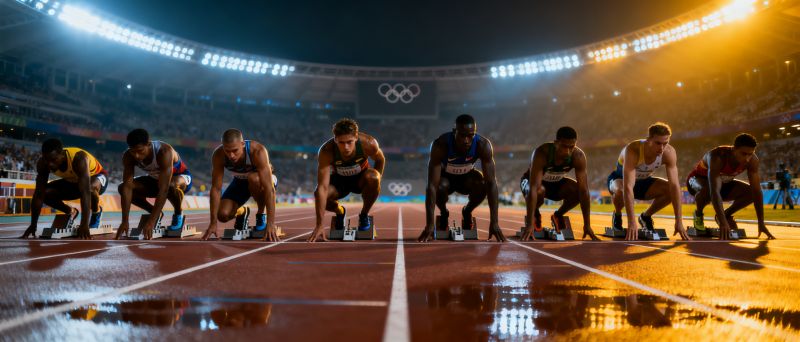
Lactic acid is the silent assassin. Around the 300-meter mark, the legs turn to concrete. The face tightens, the arms swing wider, and the stride shortens. This is where the Olympic 400m final becomes a psychological battleground. In Rio 2016, Wayde van Niekerk ran from lane 8—a blind draw—and shattered Michael Johnson's 17-year-old world record. He didn't have a visual target. He ran on feel, on faith, on a rhythm he'd rehearsed a thousand times in training. That record, 43.03 seconds, still stands. What struck me wasn't the time;it was the composure. While others grimaced and fought their own muscles。Van Niekerk's face stayed serene. That's the paradox: the 400m demands maximum output with minimum tension. Tense up, and you lose.The final 100 meters is where legends are separated from medalists. The crowd noise becomes a wall, but the athlete hears only their own breathing—ragged, desperate. Watch the shoulders. When they start rocking side to side。the race is over for that runner. The winner is often the one who maintains the highest knee lift, the most aggressive arm drive, even as the quadriceps scream. In Tokyo 2020, Steven Gardiner of the Bahamas held off a late charge from Anthony Zambrano. Gardiner's advantage wasn't raw speed;it was his ability to hold form through the final 20 meters. He didn't tighten. He didn't reach. He simply kept running his race. That's the invisible skill of an Olympic 400m champion—the capacity to execute under a fatigue so profound it distorts vision and judgment.What makes the Olympic 400m final so compelling is its brutal honesty. There are no heats to hide in, no pacing partners, no second chances. Eight lanes。
one lap, and a lifetime of training distilled into less than a minute. The event rewards the patient and punishes the reckless. It also exposes the myth of natural talent. You can't fake a 400m final. The race strips you down to your conditioning, your discipline, and your willingness to suffer. I've watched dozens of these finals, and the pattern holds: the athlete who looks smoothest at 350 meters is almost always the one who crosses the line first. Smoothness, not speed, is the currency of the 400.The Olympic 400m final is a masterclass in restraint. It's a sprint that demands the mindset of a distance runner. The winners are rarely the fastest starters;
they are the smartest finishers. They know when to press。when to float, and when to unleash. That knowledge, earned through countless repetitions and painful lessons, is what separates a gold medal from a footnote. When the next final unfolds, ignore the first 200 meters. Watch the faces at 300. That's where the truth lives.